You Won’t Believe This Hidden Himalayan Gem’s Ancient Architecture
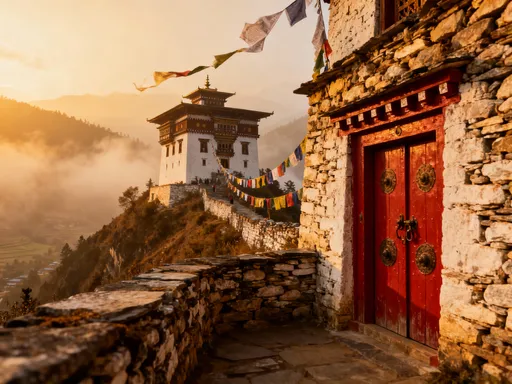
Nestled in the heart of the Himalayas, Paro, Bhutan, feels like a world frozen in time. I didn’t expect to be so moved by its ancient architecture—colorful wooden windows, hand-carved motifs, and fortress-like dzongs rising from misty valleys. It’s not just beautiful; it’s deeply intentional. Every stone and beam tells a story of culture, faith, and harmony with nature. This is travel that touches your soul. In a world where modernity often erases tradition, Paro stands as a rare testament to architectural continuity. Here, buildings are not merely shelters but living expressions of identity, spirituality, and environmental wisdom. What makes this valley so extraordinary is not just what you see, but how it makes you feel—grounded, reverent, and quietly inspired.
Arrival in Paro: First Impressions of a Timeless Valley
Descending into Paro by air is an experience unlike any other. As the plane banks sharply through narrow mountain passes, passengers are treated to breathtaking views of snow-capped peaks and deep green valleys carved by ancient rivers. The Paro International Airport, one of the most challenging in the world for pilots, sits in a valley surrounded by towering ridges, offering an immediate sense of isolation and serenity. Upon stepping onto the tarmac, the cool mountain air carries a crisp clarity, and the first sight of traditional Bhutanese homes lining the roadside sets the tone for the journey ahead.
These homes, even in their simplicity, are architectural statements. Their whitewashed walls rise with gentle tapering, crowned by sloping wooden roofs designed to shed heavy monsoon rains. Brightly painted wooden windows, often framed in red or blue, feature intricate latticework and symbolic carvings. Even small roadside shrines—stone altars adorned with prayer flags and butter lamps—reflect the same design principles seen in grand monasteries. This architectural consistency is no accident; it is the result of deliberate national policy and cultural pride.
Bhutan has long prioritized cultural preservation over unchecked development. Since the 1970s, the government has enforced strict building codes requiring all new constructions, even private homes and public buildings, to adhere to traditional Bhutanese design. This means no glass towers, no concrete boxes—only structures that harmonize with the landscape and echo centuries-old forms. In Paro, this commitment is visible everywhere, creating a visual continuity that few places on Earth can match. For visitors, the effect is profound: it feels less like tourism and more like stepping into a living heritage.
The Heart of Tradition: Exploring Rinpung Dzong
Rising above the Paro Valley like a sentinel from another age, Rinpung Dzong is the spiritual and administrative heart of the region. Built in the 15th century and expanded over generations, this massive fortress monastery clings to a rocky spur, connected to the valley floor by a single traditional cantilever bridge. Its name, meaning "Heap of Jewels," reflects its sacred status. The dzong’s imposing stone walls, constructed without mortar, have withstood centuries of wind, rain, and seismic shifts, a testament to the ingenuity of Bhutanese engineering.
Entering through the heavy wooden gates, one is immediately struck by the contrast between the dzong’s defensive exterior and its spiritually rich interior. Narrow staircases wind upward to open courtyards where monks in maroon and saffron robes move quietly between temples. The walls are adorned with vivid frescoes depicting Buddhist teachings, protector deities, and historical events. Prayer halls echo with the sound of chanting, and the air carries the scent of incense and aged wood. Every element—from the placement of windows to the alignment of prayer rooms—follows sacred geometry, believed to channel positive energy and support meditation.
Rinpung Dzong is not a museum but a living institution. It serves as both a monastic school and a district administrative center, housing government offices alongside monastic chambers. This dual function reflects a unique aspect of Bhutanese society, where religion and governance are deeply intertwined. The architecture supports this balance: public spaces for officials are separated from sacred areas by symbolic thresholds, ensuring that spiritual sanctity is preserved. Even today, during the annual Paro Tsechu festival, the dzong becomes a stage for masked cham dances performed by monks, drawing thousands in celebration of faith and tradition.
What makes Rinpung Dzong truly remarkable is how its design serves multiple purposes simultaneously. Its elevated position provided strategic defense against invasions in centuries past, while its inward-facing layout fosters community and contemplation. The thick stone walls regulate temperature, keeping interiors cool in summer and warm in winter. Every architectural choice—from the narrow windows that limit exposure to harsh weather to the central courtyard that promotes natural light and ventilation—demonstrates a deep understanding of both environment and human need.
Beyond the Monastery: Everyday Architecture with Meaning
While dzongs and monasteries capture much of the attention, the true depth of Bhutanese architectural tradition lies in the everyday homes scattered across the hillsides. These family dwellings, often passed down through generations, are not replicas built for tourists but functional, lived-in spaces shaped by centuries of adaptation. Their design is both practical and symbolic, reflecting a worldview in which the sacred and the mundane coexist seamlessly.
Most traditional homes in Paro follow a similar pattern: a three- or four-story structure built from rammed earth, stone, and timber. The ground floor typically houses livestock, providing warmth and security. The middle floors contain living spaces and kitchens, while the top floor is reserved for the *choesum*, a private prayer room. This vertical arrangement is more than logistical—it symbolizes the Buddhist concept of ascending from the physical to the spiritual. The prayer room, often the most elaborately decorated space, faces east or toward a sacred peak, aligning daily life with spiritual orientation.
The exteriors are equally meaningful. Whitewashed walls are often marked with religious symbols—swirling patterns representing the eight auspicious signs, or red ochre stripes denoting protection. Wooden windows and balconies are painted in bright colors, not for mere decoration but to represent the five elements: blue for sky, white for air, red for fire, green for water, and yellow for earth. Even the roof design serves a purpose: the wide overhangs protect walls from rain, while the layered wooden shingles allow for natural insulation.
What is especially striking is how modernity integrates without disrupting tradition. It is common to see solar panels mounted on rooftops, satellite dishes discreetly placed, or electric lights glowing through prayer room windows. Yet these additions do not clash with the traditional form—they are incorporated thoughtfully, maintaining the building’s aesthetic and cultural integrity. This balance reflects a broader Bhutanese philosophy: progress is welcomed, but not at the cost of identity. For families in Paro, preserving their home’s design is an act of respect—for ancestors, for faith, and for the land itself.
Craftsmanship That Speaks: The Artisans Behind the Beauty
The enduring beauty of Paro’s architecture would not be possible without the skilled artisans who continue to practice Bhutan’s *zorig chusum*—the thirteen traditional arts and crafts. These include woodcarving, painting, masonry, weaving, and metalwork, each passed down through apprenticeships that can last a decade or more. In a world increasingly dominated by mass production, these crafts remain hand-driven, precise, and deeply spiritual.
One afternoon in Paro town, I visited a small workshop where a master woodcarver was restoring a window frame for a local home. Using chisels forged by hand and guided by decades of muscle memory, he recreated a floral motif that had adorned Bhutanese buildings for centuries. No blueprints or digital templates—just his knowledge and a few reference sketches. Each cut was deliberate, each curve shaped to convey not just beauty but meaning. The lotus, for example, symbolizes purity; the endless knot represents interconnectedness. Even the tools themselves are traditional, often made and maintained by the artisans.
Apprentices, some as young as twelve, watch and learn in silence for years before being allowed to make their own marks. This slow, disciplined process ensures that the craft is not just preserved but understood at a deep level. The government supports this tradition through the National Institute for Zorig Chusum in Thimphu, where students train in all thirteen arts. Graduates often return to their communities, bringing their skills to restoration projects and new constructions alike.
The role of these artisans extends beyond construction. They are cultural custodians, ensuring that every carved beam, every painted door, and every stone laid follows the correct proportions and symbolism. Machines may cut wood faster, but they cannot replicate the intention behind each stroke. In Bhutan, craftsmanship is not a trade—it is a form of meditation, a way of honoring the divine in the details. When visitors admire the beauty of a dzong or a home, they are not just seeing architecture; they are witnessing generations of dedication made visible.
Tiger’s Nest: Where Architecture Meets the Impossible
No discussion of Bhutanese architecture is complete without Taktsang Palphug Monastery, better known as Tiger’s Nest. Perched on a sheer cliff 900 meters above the Paro Valley, this sacred site seems to defy logic. According to legend, Guru Rinpoche, the saint who brought Buddhism to Bhutan, flew here on the back of a tigress and meditated in a cave for three months. In the 17th century, a monastery was built around that cave, clinging to the rock face with astonishing precision.
The journey to Tiger’s Nest is a pilgrimage in itself. The hike, which takes about two to three hours, winds through pine forests, crosses wooden bridges over rushing streams, and ascends steep stone steps. Along the way, prayer flags flutter in the wind, their colors fading with exposure to sun and snow. As the monastery comes into view, the sight is humbling—the cluster of white and ochre buildings appears to grow directly from the cliff, supported by wooden beams anchored deep into fissures in the rock.
The structure’s design is both minimal and resilient. Built from stone, timber, and clay, it uses natural materials that blend with the environment. There are no large open spaces; instead, a series of small temples and meditation cells are connected by narrow passages and stairways. This compact footprint reduces strain on the cliffside and limits environmental impact. Despite its exposure to wind, ice, and occasional rockfalls, the monastery has stood for over 300 years, thanks to continuous maintenance by monks and skilled builders.
What makes Tiger’s Nest truly extraordinary is the intention behind its location. High above the valley, it offers solitude and silence—ideal conditions for meditation and spiritual retreat. The difficulty of access is not a flaw but a feature, ensuring that only the committed make the journey. Today, visitor numbers are carefully managed to protect the site’s sanctity and structural safety. Tickets are limited, and all tourists must be accompanied by guides. This balance of accessibility and preservation reflects Bhutan’s broader approach to heritage: openness without exploitation, reverence without exclusion.
Preservation Over Progress: How Bhutan Protects Its Built Heritage
Paro’s architectural harmony is not accidental—it is the result of deliberate, long-term policy. Unlike many tourist destinations that have sacrificed authenticity for convenience, Bhutan has chosen a different path. Since the 1970s, the government has implemented strict regulations to ensure that all new buildings, whether homes, hotels, or government offices, conform to traditional design standards. This includes requirements for roof shape, wall color, window style, and even the height of structures, which are limited to five stories to maintain the valley’s visual scale.
The Department of Culture, under the Ministry of Home and Cultural Affairs, oversees these regulations. Architects and builders must submit plans for approval, and deviations are not permitted. In Paro, this has created a townscape where even modern amenities—a bank, a clinic, a hotel—look as though they belong to the same era as the dzong. This consistency is rare in the modern world, where rapid development often leads to visual chaos.
These policies are not without challenges. As tourism grows, so does demand for infrastructure. Yet Bhutan has resisted the temptation to compromise. Instead, it has embraced a model of high-value, low-impact tourism, requiring visitors to pay a daily tariff that funds conservation, healthcare, and education. This approach ensures that tourism supports preservation rather than undermining it.
Compared to other Himalayan regions where concrete hotels and cable cars have altered the landscape, Paro remains refreshingly intact. There are no neon signs, no billboards, no high-rise resorts. Even electricity lines are buried where possible. This commitment to aesthetic and cultural continuity is not about nostalgia—it is about identity. For Bhutan, architecture is not just about how buildings look, but what they represent: a society that values balance, mindfulness, and respect for nature.
Why This Architecture Matters—Beyond Aesthetics
The architecture of Paro is not merely beautiful—it is meaningful. It shapes how people live, think, and connect with their environment. Walking through the valley, one begins to notice how the design of buildings encourages slowness, contemplation, and community. Narrow streets invite conversation; courtyards foster gathering; prayer rooms orient life toward reflection. Even the act of climbing to Tiger’s Nest becomes a metaphor for spiritual ascent.
This architectural philosophy is deeply linked to Bhutan’s unique measure of progress: Gross National Happiness. Rather than prioritizing GDP, the country emphasizes well-being, cultural preservation, and environmental sustainability. The buildings of Paro embody these values. They are not built for speed or profit, but for harmony and endurance. They remind residents and visitors alike that beauty and function need not be separate, that tradition and modernity can coexist, and that development does not have to mean destruction.
For travelers, experiencing Paro’s architecture is not just about seeing ancient buildings—it is about feeling their purpose. It is in the warmth of a family home, the silence of a mountain monastery, the precision of a hand-carved window. These structures do not shout for attention; they whisper wisdom. They invite us to slow down, to look closely, to respect what has been preserved.
As the world grapples with climate change, cultural erosion, and the pace of modern life, Paro offers a quiet but powerful alternative. It shows that it is possible to grow without losing oneself. To visit Paro is not just to witness a hidden Himalayan gem—it is to remember what truly matters. Come with respect. Come with awareness. Come with deep curiosity. And let the stones, the wood, and the mountains speak to you, as they have for centuries.