This Is What Slow Travel Feels Like in Vik, Iceland
You know that feeling when a place just hits different? That’s Vik. I spent a week moving slow—no rush, no checklist—just letting the wind, waves, and silence speak. What I found wasn’t just black sand and puffins; it was a whole new way of seeing. This isn’t about ticking boxes. It’s about moments that stick. Standing at the edge of the Atlantic, watching basalt columns rise like ancient sentinels, I realized travel could be more than movement—it could be meditation. Vik taught me how to truly watch, and honestly? I’ll never travel the same way again.
Arrival with Intention: Why I Chose Slow Travel in Vik
Most travelers rush through Iceland’s south coast, ticking off waterfalls and lava fields on packed itineraries. But I arrived in Vik with a different purpose: to stay, not just visit. After years of fast-paced trips—where the goal was to see everything in the least amount of time—I craved stillness. I wanted to experience a place not through a camera lens, but through presence. Vik, a small coastal village nestled between dramatic cliffs and sweeping beaches, offered the perfect setting for this shift. Its remote location, lack of mass tourism infrastructure, and raw natural beauty made it ideal for slow travel.
Choosing slow travel meant rejecting the pressure to maximize every minute. Instead of booking guided tours or filling days with activities, I committed to observation. I wanted to notice how light changed over the sea at different hours, how sheep moved across hillsides without urgency, and how the rhythm of daily life unfolded in a village where everyone seemed to know one another. This wasn’t about doing more; it was about doing less, and feeling more as a result.
Vik stood out not because it’s the most famous destination in Iceland—many tourists pass through without stopping long—but because it resists the urge to perform. There are no souvenir megastores or crowded viewpoints at dawn. The landscape remains untamed, and the atmosphere encourages reflection rather than consumption. By choosing to move slowly here, I wasn’t just changing my travel habits; I was redefining what connection to a place could mean.
The Black Sand That Changes Everything: Reynisfjara Without the Crowd
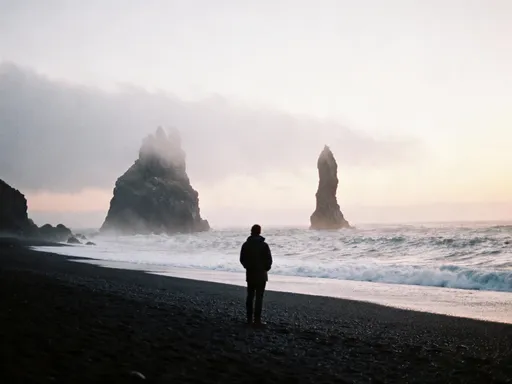
Reynisfjara Beach is one of Iceland’s most photographed spots, known for its volcanic black sand, towering basalt columns, and powerful Atlantic waves. But most visitors experience it in fleeting moments—pulling over during a road trip, snapping photos, then moving on. I went at dawn, when the parking lot was nearly empty and the air carried a quiet hush. The absence of crowds allowed something rare: intimacy with the landscape.
Walking barefoot along the shore, I felt the sand’s coarse texture shift underfoot—cooler near the water, warmer in patches where the sun had touched. The waves didn’t roar; they pulsed, retreating with a hiss before gathering strength for the next surge. Seabirds called from the cliffs above, their cries echoing against the hexagonal rock formations that looked like the work of giants. I sat on a smooth stone and simply watched. No agenda, no timer. Just the sea, the sky, and the slow reveal of details most people miss.
Slowing down transformed my perception. I noticed how the tide carved temporary pools in the sand, how tiny crustaceans darted between pebbles, and how the light turned the basalt pillars from charcoal gray to deep violet as the sun rose. These were not grand spectacles, but subtle wonders—accessible only to those willing to wait. Yet, with this beauty comes danger. The Atlantic here is unpredictable, and sneaker waves have swept visitors off the rocks. Respecting the power of the ocean is not just a safety rule; it’s part of the slow travel ethic. To be present means acknowledging nature’s force, not just its beauty.
By visiting off-peak and staying longer, I avoided the congestion that often diminishes such places. I saw families taking cautious steps near the water, rangers reminding visitors to stay back, and tourists pausing not just to photograph, but to absorb. There’s a growing awareness that these landscapes demand reverence. At Reynisfjara, slow travel isn’t just rewarding—it’s responsible.
Puffins, Patience, and Presence: Birdwatching the Slow Way
One of the highlights of visiting Vik in summer is the chance to see Atlantic puffins, those charming seabirds with colorful beaks and comical waddles. They nest in burrows along the cliffs of Dyrhólaey, a promontory just north of the village. Tour buses arrive mid-morning, disgorging dozens of people armed with long lenses. But I waited until late afternoon, when the light softened and the crowds thinned.
From a respectful distance, using only binoculars, I watched a pair of puffins return to their burrow with beaks full of sand eels. They didn’t perform for an audience. They went about their business—feeding their chick, preening, resting—unbothered by onlookers who kept their distance. There was no flash, no sudden movements, just quiet observation. In that stillness, I saw behaviors rarely captured in photographs: the gentle nudge between mates, the careful inspection of the burrow entrance, the way one bird stood guard while the other disappeared inside.
Patience was rewarded. After nearly an hour of waiting, a young puffin poked its head from the grass, curious but cautious. It didn’t fly away immediately. It scanned its surroundings, flapped its wings experimentally, then retreated. These moments weren’t staged. They unfolded naturally, visible only to those who stayed long enough to witness them. This is the essence of ethical wildlife viewing: not intrusion, but invitation. The birds didn’t owe me a photo. I was the guest.
Slow birdwatching also deepened my appreciation for the ecosystem. Puffins are indicators of ocean health, and their declining numbers in some areas reflect broader environmental challenges. By observing them without disruption, I felt more connected to their survival. It wasn’t just about seeing a cute bird; it was about understanding its role in a fragile balance. Quiet presence fosters respect in a way that hurried tourism cannot. When we stop chasing moments, we start living them.
Driving the South Coast Like a Local: Pauses Over Speed
Route 1, the Ring Road that circles Iceland, passes directly through Vik. Most drivers treat it as a thoroughfare—zooming past sheep crossings and weather warnings on their way to waterfalls like Skógafoss or Seljalandsfoss. But I drove it differently. I treated the road not as a path to somewhere, but as part of the journey itself. I gave myself no deadlines. I stopped when the fog rolled in, when a flock of sheep blocked the road, or when the late afternoon light turned the mountains gold.
One morning, I pulled over at an unmarked viewpoint, drawn by the way mist clung to the cliffs above the ocean. There was no parking lot, no sign, no other cars. Just a dirt shoulder and a view that stretched endlessly. I sat on the hood of my car with a thermos of tea, watching the fog shift like breath across the land. It was one of the most memorable moments of the trip—not because it was dramatic, but because it was unplanned. Slow driving creates space for such serendipity.
Other stops included a hidden cove where waves crashed against sea stacks, a grassy hillside where wild horses grazed in silhouette, and a roadside stand selling homemade rhubarb jam. These weren’t on any tourist map, but they were real. They belonged to the rhythm of local life. By moving slowly, I began to sense that rhythm—the way weather dictated movement, how animals had priority on the road, and how light changed everything in a matter of minutes.
Driving like a local meant adopting a mindset of openness. It meant being willing to reroute for a sudden downpour, to wait out a storm in a small café, or to let a herd of sheep cross at their own pace. It wasn’t always efficient, but it was deeply human. The South Coast stopped being a list of attractions and became a living landscape, breathing and shifting with the hours. That’s what slow travel does: it turns transit into experience.
Staying Small: Choosing Family-Run Stays Over Tourist Traps
In a world of chain hotels and short-term rentals, I chose to stay at a family-run guesthouse in the heart of Vik. It was a modest building with a red roof and flower boxes, run by a couple who had lived in the village for decades. My room was simple—clean, warm, with a view of the church steeple and the distant mountains—but it was the hospitality that made it special.
Each morning, breakfast was served at a shared table. We ate fresh bread, skyr with local honey, and boiled eggs, while the owners shared stories about life in Vik. They spoke of winters with endless darkness, of storms that knocked out power for days, and of the quiet pride in raising children in a place so close to nature. These conversations weren’t performances for tourists; they were genuine exchanges. I wasn’t a customer—I was a guest.
Staying small had deeper implications. By choosing locally owned accommodations, I supported families rather than distant corporations. I contributed to a community that values sustainability and authenticity. The guesthouse used solar panels, collected rainwater, and sourced food from nearby farms. These weren’t marketing points; they were everyday practices. It was a model of tourism that gives back, rather than takes.
At night, I sat in the common room with other travelers—Dutch retirees, a German student, a Canadian artist—sharing stories over tea. There was no Wi-Fi in the lounge, which encouraged real conversation. We talked about what we were seeking, why we had come to Iceland, and what we hoped to carry home. These moments of connection reminded me that travel is not just about seeing new places, but about meeting new people and seeing ourselves differently. A small stay created space for big reflections.
Weather as a Travel Companion, Not an Obstacle
Iceland’s weather is famously unpredictable. In Vik, I experienced all four seasons in a single day—sunshine, rain, wind, and even a dusting of snow in June. At first, I saw these shifts as disruptions. I had planned to hike, to photograph, to explore. But when a storm rolled in mid-morning, trapping me indoors, I had a choice: resist it or embrace it.
I chose the latter. I wrapped myself in a wool blanket, brewed ginger tea, and watched the rain streak across the window. The church steeple vanished into the mist. Sheep huddled under rock overhangs. The ocean turned steel gray. It wasn’t ruined; it was transformed. The storm wasn’t an enemy of travel—it was part of the story. In fact, some of my most vivid memories came from these moments of stillness: the sound of wind rattling the eaves, the smell of wet earth after a downpour, the way the light returned, softer and more golden, when the clouds broke.
Embracing the weather changed my mindset. I stopped seeing rain as a reason to stay indoors and started seeing it as a reason to adapt. I learned to pack accordingly—waterproof layers, insulated boots, quick-dry clothing—and to carry a sense of flexibility. I discovered that fog could make a landscape more mysterious, that wind could sharpen the senses, and that sudden sun after rain felt like a gift.
This acceptance extended beyond comfort. It became a metaphor for life. Just as I couldn’t control the weather, I couldn’t control every moment of my trip. But I could control my response. By staying present—by noticing how the world changed with each shift in conditions—I deepened my connection to the place. Weather wasn’t an obstacle; it was a companion, shaping the journey in ways I hadn’t planned but came to cherish.
Leaving With More Than Photos: The Lasting Impact of Deep Viewing
When I packed my bags to leave Vik, I had a memory card full of images. But the photos weren’t what stayed with me. It was the feeling of standing on the cliffs at dusk, watching the last light catch the edge of a puffin’s wing. It was the sound of the Atlantic at 5 a.m., when the world was still asleep. It was the warmth of the guesthouse kitchen, where strangers became friends over steaming mugs of tea.
Slow travel didn’t just change how I saw Vik—it changed how I see everything. I became more attentive, more patient, more willing to sit with uncertainty. I noticed details in my own neighborhood that I had overlooked for years: the way leaves tremble in the wind, how neighbors wave from their porches, the quiet rhythm of daily life. The stillness I found in Iceland didn’t stay there; it traveled home with me.
This kind of deep viewing is a quiet rebellion against the speed of modern life. In a world that glorifies busyness, choosing to pause is radical. It says that presence matters more than productivity, that observation is as valuable as action. Vik didn’t offer grand revelations—it offered small, cumulative truths. That beauty often hides in plain sight. That connection grows from time, not speed. That sometimes, the most powerful thing we can do is simply look.
As I boarded the bus back to Reykjavík, I didn’t feel the usual post-trip melancholy. I felt full. Not with souvenirs or checkmarks, but with a renewed sense of wonder. I carried the whisper of the wind, the memory of black sand underfoot, and the understanding that travel isn’t about how far you go, but how deeply you go. Vik taught me that.
Vik doesn’t shout—it whispers. And only when you slow down can you hear it. This kind of travel isn’t about how many sights you see, but how deeply you see one. In a world that races, choosing to pause is revolutionary. Let Vik be your reminder: sometimes, the greatest journey is simply learning how to look.